


 Contact Support
 Sign In
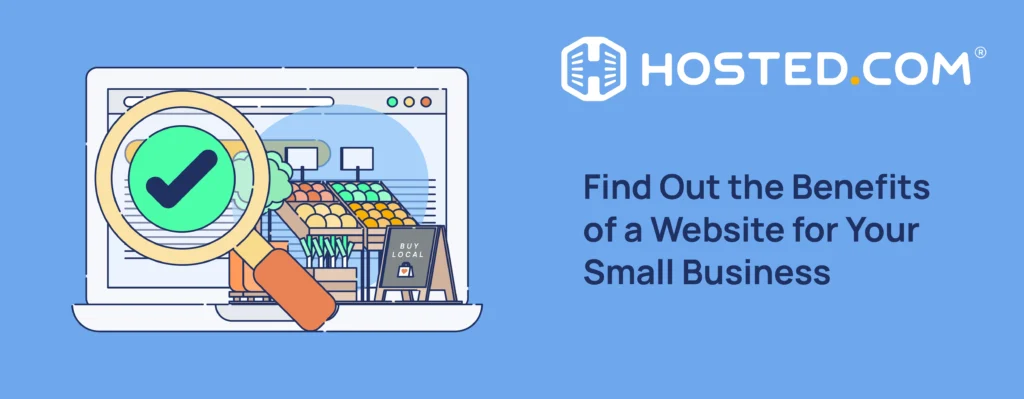
A business without a website is operating with an unnecessary handicap. More than ever, people search, compare, and decide everything from a computer screen or mobile device, without ever seeing a product in person. A well-built website for small business places yours in the running with credibility and authority. For a smaller business looking to expand its reach, boost sales, improve credibility, and grow, a professional website becomes more than a marketing tool to get the word out. It becomes a central part of your growth. This guide explains the top benefits of a website for small business growth, why they matter, and how the right tools like the Hosted.com® Website Builder can help you make the most of these advantages, even if you’ve never built a site before.
KEY TAKEAWAYS
- A small-business website acts as the center of your operations that you own, customize and use to grow.
- The benefits of a website for small business include visibility, trust, improved marketing, faster conversions, expansion, and customer satisfaction.
- The Hosted.com® Website Builder helps small businesses launch a site quickly, affordably, and with minimal technical knowledge.
TABLE OF CONTENTS
What Is a Website for a Small Business?
Gone are the days of relying solely on word of mouth, social media, and even physical stores. These can no longer compete with the internet’s speed and scale. A website extends your business’s reach far beyond your local network or area. It works for you by providing potential customers with 24/7 access, presenting your products and services professionally, and acting as a hub for marketing, sales, customer engagement, and brand building. For a small business owner to grow and compete in their chosen market niche, having a website is often the foundation of success.
A good website is where people learn about what you do, what you sell, and why they should choose you. This should include a homepage, an About Us page, service or product pages, contact information, and a blog or resources section.
Through it, you control how your brand looks and feels with your specific colors, logos, tone, messaging, and visuals. You also ensure your brand identity is consistent and matches your other platforms.
Your site can integrate with digital marketing efforts, including SEO (Search Engine Optimization), content such as blog posts, and email newsletters, making it central to your growth and new customer acquisition. Similarly, adding contact forms, chatbots, FAQs, and resource pages helps you connect with your target audience, building trust and increasing customer loyalty.
As your online business moves to the next level, your website can grow with it, adding more products, advanced features and functionality, and handling sudden traffic spikes as you tap into new markets.
7 Key Benefits of a Website for Small Business Growth
The benefits of a website for small business go well beyond having a few web pages for people to look at. Here are seven long-term benefits for yours:
1. Visibility & Organic Traffic
First and foremost, having your own website helps potential customers find your business by giving search engines the correct signals about what you offer and how you can meet customer needs. When people search for solutions to specific pain points, a well-structured site with authoritative, relevant content, accurate information, and a smooth, safe user experience can often rank higher in search results and attract more traffic.
For small businesses, this increased visibility and web traffic helps grow conversions and attract a wider audience by showing people who are actively searching for the products and/or services you offer, that your brand exists.
2. Stronger Credibility & Trust
As we mentioned, having a polished website shows professionalism, and this perception directly affects sales, as 81% of shoppers research a business online before making a purchase.
Without one, many potential customers could assume your business is unreliable or of low quality. On the other hand, people tend to trust businesses that provide easily accessible contact details (phone number, email address, location), business hours, privacy policies, and other important information.
Having trust signals like reviews, testimonials and SSL (Secure Sockets Layer) certificates also adds another layer of credibility. It shows website visitors your business is stable, transparent, and committed to quality. This helps you stand out from competitors in your niche. Small businesses can compete better when they present themselves as structured, professional, and capable.
By demonstrating expertise through guides, tutorials, and clear product descriptions, your small business can stand out in ways other brands may overlook. Personalized content, tailored customer experiences, and authentic messaging can influence peoples’ buying decisions strongly.
To quote Danoe Santoso in a July 22, 2025, blog post for Nexalab Blog, “In this 2025 AI-digital age, a professional-looking website is often the first indicator of a business’s legitimacy.”
3. Better Branding & Marketing
When it comes to marketing, many businesses use third-party tools, marketplace listings, and social media platforms to reach customers. While these channels are essential for visibility, they can limit your control over brand awareness and how people perceive your business. A website gives your brand a home base where you have full control over how you convey your story, values, and strengths.
By carefully designing landing pages, product information, and visuals, a small business can create a clear, consistent brand identity that helps customers understand what makes it worth choosing and remember it later. It also helps reduce the risk of people seeing outdated or inaccurate information.
Following that, a well-designed website can improve marketing ROI by turning traffic from links into conversions. It helps boost the impact of social campaigns, paid ads, newsletters, content marketing, and your SEO strategy. This is because they all lead back to the site, where it can convert interest into income.
Marketing campaigns generally perform better when visitors land on pages that answer their questions with clear calls to action (CTAs). Without one, no matter how well-thought-out and executed a marketing plan is, it can be difficult to track customer behavior. With one, small businesses can run structured campaigns that connect and convert.
This sentiment is summed up well by Matthew Vermillion, Co-Founder of Artifact Branding & Marketing, who says, “Powerful websites are built to achieve specific business goals with a tightly defined audience.”
4. Faster Conversions
24% of small businesses use their websites to showcase products or services. These days, customers also want clarity and speed. By clearly explaining products, providing transparent pricing, and offering easy checkout or booking options, small businesses can speed up the buying process.
Businesses that use only manual quoting or in-person discussions often experience delays, which can cause potential clients to lose interest or select a competitor. A website can immediately provide customers with the correct information and options and make them act. Conversion-focused features such as CTAs, free trials, booking forms, and product pages further speed up the process.
Compared to social search or ads that appear only briefly in people’s feeds, a website allows for much more customer engagement. Visitors can explore at their own pace, compare options, and make informed decisions before they purchase. Creating targeted pages for specific audiences can often also increase conversion rates.
5. Reach & Customer Retention
Having a website allows many local businesses to reach a wider customer base, locally and internationally. This extended reach is helpful when you are in a specific niche, as it attracts interest from dedicated markets such as hobby or fandom groups worldwide.
International shipping options, selling digital products, virtual consultations, and offering remote services can provide access to markets that were previously out of reach, increasing revenue and supporting long-term growth.
Once you have the reach, you need to retain it. Customer retention depends on familiarity and ongoing value. Your site can help keep people returning through regular updates, exclusive content, membership tiers, reward programs, and online shopping discounts.
Visitors who regularly return to the site become more invested in your business, helping build relationships, gather feedback, and encourage repeat purchases.
6. Improved Support & Self-Service
One of the most practical benefits of a website for small business growth is being able to help customers almost instantly. Customers value direct access to information, and a website can consistently deliver it. For example, people can find answers by checking FAQs, learn about products through articles and blog posts, or troubleshoot with guides and video tutorials.
Self-service tools are helpful for time-pressed teams and micro-businesses that may not have full-time support staff. Customer satisfaction tends to increase when people can find their own answers quickly, making them more likely to return.
On your side, communication tools like live chat widgets, contact and booking forms, and automated responses help increase engagement without requiring extra staff or taking up unnecessary time.
Similarly, automating tasks that normally require manual input, such as invoicing, sending reminders and downloads, and client onboarding, improves efficiency and reduces errors.
This means you have more time to focus on your core business goals rather than on admin, especially if you have a solo operation or a small team.
7. Analytics & Expansion
Without a website, it is difficult to understand visitor behavior. With one, you can track visits, search queries, trends, engagement patterns, and purchasing activity. These reveal what site visitors care about, which product pages need work, and where your marketing budget should be directed.
Analytics enable a small business to make decisions based on real-time data, rather than guessing what your customers want. You can then tailor content, promotions, and new product development accordingly.
As your business grows based on the analytics information gathered, you can also start adding new products, services, features, and interactivity to your site, including member dashboards, subscription products, and AI tools. These all encourage people to spend more time on pages, which increases online sales. Without a website, expanding your offerings can be far more difficult.
The Hosted.com® Website Builder for Your Small Businesses
For many small businesses, understanding why they need a website is one thing, but knowing how to build and launch one quickly, affordably and without worrying about the technical stuff is another.
About half of all small businesses with websites manage them in-house, while 32% use website builders to set up a basic site.
The Hosted.com® Website Builder is an add-on to our cPanel Web Hosting plans. It offers beginners and SMEs a complete site creation platform with a simple browser-based interface, meaning you don’t need to install any software or have coding knowledge. You can go from zero to a professional-looking website, with no web development experience required.
The first step is to select from over 200 professionally designed templates, covering a wide range of industries and styles. The templates are all fully mobile-responsive, so your site loads and displays well across different devices and screen sizes.
Next, the drag-and-drop editor allows you to customize your layout to fit your branding, place text, images, buttons, galleries, forms, and other features without writing a single line of code.
As a business, you will need ecommerce website support. That’s why we include a range of features for product management, secure payment gateways, shopping carts, and easy checkout, letting you build an online store without requiring separate software or linking to external platforms.
The builder offers editable meta tags, a clean URL structure, sitemap generation, and easy integration with tools like Google Analytics, helping you check website statistics, optimize for better rankings, and track visitor behavior.
Because the Website Builder is bundled with the Hosted.com® Web Hosting plans and the cPanel control panel, you have everything you need to run your new site, including a free domain name registration*, email accounts, hosting, and content in one place.
When it comes to securing your files and customer data, we include a free SSL certificate, advanced malware detection and removal software, and daily backups.
Lastly, our plans are designed to be flexible. As business needs change, for example, launching an online store, adding more pages, or integrating more features, the platform can scale right with you.
This means you get all the major benefits of a website for small business growth (visibility, credibility, accessibility, marketing, flexibility) with lower upfront costs and maximum control, without the technical headaches. All backed by high-performance server infrastructure, a 99.9% uptime guarantee, and expert support.
![Strip Banner Text - : Build the Website Your Small Business Needs to Succeed [Read How]](webp/benefits-of-a-website-for-small-business-04-1024x229.webp ": Build the Website Your Small Business Needs to Succeed [Read How]")
Getting Started with Hosted.com® Website Builder
VIDEO: Getting Started with Hosted.com® Website Builder
FAQS
What is the main benefit of a website for small business growth?
It provides visibility, trust, and consistent branding, and helps improve marketing to convert interest into sales.
Can a website help me attract customers outside my city or country?
Absolutely. A website makes your business discoverable globally to people who search online for the products or services you offer, using optimized content and the right SEO strategy.
Is a website still necessary if my business has social media profiles?
Yes. Social media profiles do not offer the control, depth, structure, or conversion tools that a website provides.
How often should I update my website?
At least quarterly. Product details, service pages, pricing, and contact information should be regularly updated.
How much does it cost for a small business to launch a website?
Costs vary depending on the design, complexity, and web hosting. Using a website builder allows small businesses without technical experience to launch a professional site affordably, rather than hiring a web developer.
What kind of content should I include on my website?
At a minimum, include clear information about your products or services, contact details, and an About Us page. For better results, include high-quality images, customer reviews, a blog or resource section, and tools such as contact forms or chat support.
Other Blog of Interest
– Website Development Process From Concept to Launch
– Website Launch Checklist – Pre and Post Launch Essentials
– Effective Product Launch Strategies That Deliver Results
– Web Hosting Vs Website Builder – Key Differences
– Website Builder Vs WordPress – Ways To Build Websites
- About the Author
- Latest Posts

Rhett isn’t just a writer at Hosted.com – he’s our resident WordPress content guru. With over 7 years of experience as a content writer, with a background in copywriting, journalism, research, and SEO, and a passion for websites.
Rhett authors informative blogs, articles, and Knowledgebase guides that simplify the complexities of WordPress, website builders, domains, and cPanel hosting. Rhett’s clear explanations and practical tips provide valuable resources for anyone wanting to own and build a website. Just don’t ask him about coding before he’s had coffee.